

Why Engineering Ventures Need a Different Kind of Adviser
In our experience, many engineering ventures do not fail because the technology is wrong. They fail because the commercial model arrives too late. That gap between a working prototype and a commercially viable product is the Valley of Death, and it is where most of the value is won or lost. This guide from P1 Carbon Solutions examines what good commercialisation support for engineering ventures actually looks like in 2026, and how to choose a partner without paying for a brand name you do not need.
The pattern is familiar to anyone who has sat in a board meeting at a deep-tech startup. The prototype works. The lab results hold. Then someone asks who is going to manufacture it, at what unit cost, and against which contract terms, and the room goes quiet. Large consultancies will happily answer those questions, but the answer arrives weeks or months later, in a deck priced for an enterprise budget.
A specialist alternative offers something different: the same rigour applied to a narrower problem, delivered by people who have sat on the other side of the table. Below, we break down what to expect from each type of provider, how to build a commercialisation roadmap, how engagements are priced, and the questions that separate a genuine partner from a costly invoice.
The cost and rigidity problem with large consultancies
Big firms bring scale and a recognisable logo. What they rarely bring is flexibility. Engagement structures are often fixed, teams rotate, and the person who sold you the work is seldom the person doing it.
For an early-stage venture, that structure works against you. You need commercial judgement applied weekly, not a six-month diagnostic. You need someone who will sit with your CTO and a tier-one buyer in the same room. Large providers are built for enterprise programmes, and their overhead reflects it.
What a specialist alternative offers instead
A specialist consultancy brings three things a generalist cannot. First, pattern recognition within a narrow sector. Second, direct relationships with component manufacturers and OEMs. Third, a commercial model that scales with the stage you are actually at.
Pro Tip: Ask any prospective adviser to name the last three supply agreements they personally supported and what went wrong in each. A specialist will answer in specifics. A generalist will describe a methodology.
Your Options Compared: What to Expect from Each Type of Provider
Not every option is the same shape. The right choice depends on where your venture sits between prototype and production.
Provider type | Typical engagement | Best for | Main limitation |
|---|---|---|---|
Large multi-service firm | Fixed-scope diagnostic or programme | Enterprise-scale transformation, regulated markets | High cost, slow mobilisation, junior delivery teams |
Boutique strategy house | Short advisory sprint | Board-level positioning, fundraising narrative | Limited operational depth in supply chains |
Engineering consultancy | Technical programme or work package | Validation, testing, design for manufacture | Commercial and procurement depth varies; priced for larger programmes |
Catapult or APC-backed programme | Grant-linked or subsidised support | Facilities, funding access, technical validation | Application cycles and eligibility rules; not a commercial negotiator |
Engineering commercialisation specialist | Retained, milestone-linked advisory | Prototype-to-production transition, tier-one partnerships | Narrower service range by design |
Interim commercial hire | Day-rate, embedded | Filling a temporary gap in the leadership team | Capability often leaves when they do |
The comparison is not about which type is objectively better. It is about matching the engagement model to the problem. A venture trying to land a tier-one manufacturing partnership needs operational depth in procurement and supplier negotiation. A venture preparing for a funding round needs a defensible commercial narrative. Those are different jobs.
What most guides miss is that the cheapest option is rarely the lowest fee. It is the engagement that produces a decision you can act on within the quarter.
Engineering Commercialisation Consultancy: What It Actually Involves
Commercialisation is the work of converting technical capability into a commercially viable product, supply chain and contract structure. It sits between engineering and business development, and it is where most ventures have the least internal capacity.
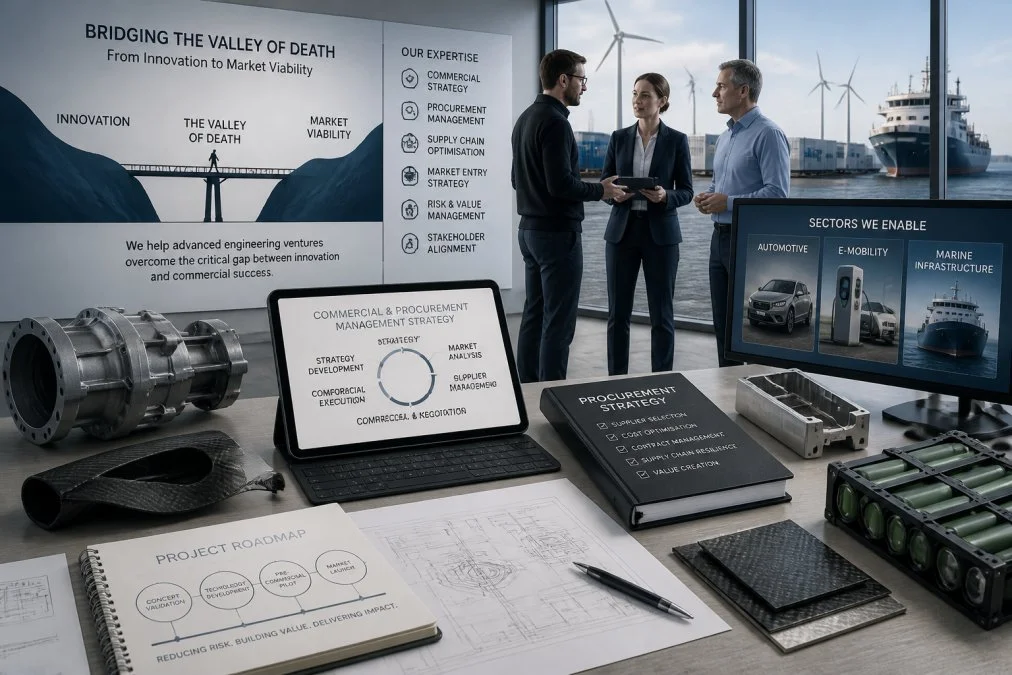
In practice, the work covers four areas. Cost modelling at volume, so you know whether the unit economics survive production. Supplier identification and qualification, so you are not dependent on a single unproven source. Contract architecture, including tooling ownership, IP boundaries and volume commitments. And a commercial roadmap that investors and procurement teams can both interrogate.
At P1 Carbon Solutions, this is the core of what we do. Our approach was built in senior commercial and procurement roles at McLaren Automotive and across clean-technology programmes, and we work directly with component manufacturers, OEMs and emerging technology platforms. That matters because the questions a tier-one buyer asks are specific, and rehearsed answers do not survive contact with them.
Case Study: An early-stage battery technology company needed independent validation testing before it could put its product in front of OEM customers. The test-house proposal was technically sound, but the commercial terms were not: payments front-loaded, cancellation exposure open-ended, and scope that did not line up across packages. Our founder led the work, normalising scope across competing labs, then rebuilding the payment schedule and cancellation terms so the venture’s exposure tracked the test programme rather than running ahead of it. The outcome: three test packages worth around £113k contracted on terms the business could absorb if the programme changed, with testing under way within weeks.
Building a Commercialisation Roadmap for Engineering Ventures
A commercialisation roadmap is a sequenced plan that links technical milestones to commercial commitments, with a decision gate between each stage. The roadmap is not a strategy document. It is a working tool that tells you what must be true before you spend the next tranche of cash.
Good roadmaps share a structure. They define the production intent early, even when it will change. They identify which suppliers must be qualified before which customer conversations can progress. They set a cost target and track it against engineering change requests. And they name the person accountable for each gate.
From prototype to production: the milestones that matter
Design freeze readiness. Can the design be manufactured at the target volume without further change?
Supplier qualification. Have critical components been sourced from at least two qualified suppliers, or is there a documented mitigation where dual-sourcing is not viable?
Cost at volume. Does the modelled unit cost support the target price and margin?
Contract structure. Are tooling, IP and volume commitments defined and defensible?
Production readiness. Has the manufacturing partner signed off on the process?
Each milestone is a gate, not a tick-box. A venture that reaches design freeze without a cost model at volume is not ready to freeze the design.
Procurement Strategy for Engineering Businesses: The Overlooked Differentiator
Procurement is often the most under-invested area in the prototype-to-production transition. Ventures treat procurement as an administrative function and then discover, at the worst possible moment, that their supply chain cannot support the contract they have signed.
A credible procurement strategy answers five questions. Which components are single-source, and what is the mitigation? What are the lead times, and how do they interact with the production ramp? Where does tooling sit on the balance sheet, and who owns it if the relationship ends? What are the volume commitments, and what happens if demand falls short? And what is the total landed cost, not just the unit price?
The difference between a venture that scales and one that stalls often comes down to how early those questions were asked. P1 Carbon Solutions works with leadership teams to answer them before they become contractual problems, which is where cost structures and supply chain resilience are actually won.
How Commercialisation Support is Priced
Fee structure shapes behaviour, so it is worth understanding before you compare proposals.
Day rate. Flexible and easy to start or stop. Best for defined, short pieces of work. The risk is open-ended spend if scope is not managed.
Monthly retainer. A set number of days or a standing commitment each month. Best for ongoing commercial leadership through a production ramp. Agree deliverables, not just availability.
Milestone-linked fees. Payment tied to defined outputs, such as a qualified second source or a signed supply agreement. Aligns incentives, but milestones must sit within the adviser's influence to be fair to both sides.
Success or equity elements. Sometimes offered alongside a reduced fee for early-stage ventures. Can align interests, but complicates the cap table and the adviser's independence.
What Good Engineering Scale-Up Consulting Looks Like
Engineering scale-up consulting should feel uncomfortable. If every meeting confirms what you already believe, you are paying for validation, not advice.
Good scale-up consulting does four things well. It tells you which of your assumptions will not survive due diligence. It brings supplier and buyer perspectives into the room before you commit. It sequences commercial commitments so you are never exposed on more than one front. And it hands over capability, so your team can run the next phase without the adviser.
The test is straightforward. Six months after the engagement ends, is your team making better commercial decisions on its own? If the answer is no, the consultancy sold you a dependency rather than a capability.
How to Evaluate a Commercialisation Partner: A Decision Framework
Choosing a partner comes down to evidence, not credentials. Use this framework to score each provider before you sign.
Score each question 1 to 5, then weight by importance to your venture:
Can they name comparable engagements in your specific sector, with outcomes?
Will the person who sold the work be the person delivering it?
Is the fee structure linked to milestones or clear deliverables rather than time?
Do they have direct relationships with the OEMs or tier-one suppliers you need?
Have they worked with a team of your current size?
Will they tell you what you do not want to hear, in writing?
Do they hand over the methodology and tools at the end?
A provider that scores well on credentials but poorly on delivery continuity and handover is a risk. A provider that scores well on sector specificity and measurable deliverables is worth a serious conversation.
Key Takeaway: The best commercialisation partner is not the one with the most recognisable name. It is the one whose engagement model matches your stage, whose team stays in the room, and whose incentives align with your next funding or production milestone.
Questions to ask before you sign
Ask what happens if the engagement reveals the venture is not commercially viable. Ask who owns the models and tools produced. Ask for the names of two clients who will take a reference call, and call them. Ask how the fee changes if the scope shifts. The answers tell you more than any pitch deck.
Conclusion
The hardest part of the prototype-to-production transition is not the engineering. It is making commercial decisions early enough, and with enough evidence, that the venture survives the funding gap. Choosing the right advisory partner is part of that decision.
P1 Carbon Solutions exists to bridge that gap. We bring sixteen years of senior automotive commercial and procurement experience, including time at McLaren Automotive, direct collaboration with component manufacturers and OEMs, and a focus on de-risking operational roadmaps so engineering concepts become profitable, market-ready realities. If you are weighing up commercialisation support for your venture and want an honest assessment of what your commercial model can support, get in touch with our team and start the conversation.